How to Develop Empathy and Practice it in Relationships
There are so many misconceptions about what exactly empathy is and why it’s important. Most people were not taught or told the value of identifying, labeling, and validating our own feelings let alone those of others. The problem with empathy gaps isn’t a lack of care or some sign of sociopathy (or even strength) but a lack of skill and practice in accessing and understanding subjective emotional experiences. This is often tethered by a fundamental miseducation or belief about the value and importance of empathy as a life skill. Though many people can go their entire lifetime without really mastering this skill, I’d argue it makes for a less vivid life and one where you can only get so close to the people most dear to you.
Empathy is often described as “putting yourself in another’s shoes” and being able to mentalize—or truly imagine what it’s like to inhabit the mind, heart, and subjective reality of another person. This is a tall order for anyone who grew up in an environment that discouraged exploring and listening to internal cues, those who were implicitly or explicitly told to suppress their emotions, who never immersed themselves in literature, poetry, or any other art form that nourished mentalization, and who struggle to imagine or abstractly picture the complex way in which different human beings experience the world.
People whose empathy muscle was never exercised in childhood and before a romantic relationship called for it oftentimes struggle with it due to two interlocking reasons: they can’t understand emotions outside of their own logical reasoning and they likely still have a latent core belief that empathy is weak, unnecessary, means agreement, and is counterproductive.

What Empathy Is (and What It Is Not)
Empathy is NOT agreement or approval
Empathy is NOT understanding why a feeling is “logical” or “reasonable”
Empathy is NOT helping someone stay stuck in negative feelings
Empathy is NOT having no boundaries, being weak, or not holding others accountable
Empathy is NOT avoiding telling someone something difficult or that might hurt their feelings (go for radical candor)
Empathy is the capacity to recognize, stay present with, and respond to another person’s emotional experience without trying to correct, minimize, or resolve it. Arriving at empathy does not require a conceptual map more than it does tolerating subjective reality even as no arrows in your mind point to that emotion. Empathy comes in three main forms: perspective-taking, feeling someone’s distress/emotions in your own body (embodied empathy), and compassion/concern which involves demonstrating care or softness towards the person through body language, tone, words, and actions.

One moment where I felt all three forms of empathy was when a client revealed that she lost her mom to cancer when she was 9 years old. I immediately felt a deep sadness and grief that mirrored what I noticed the client was feeling as she spoke. My body language leaned in and I was tearful with her. I voiced to her how incredibly gut wrenching it must have been for her mom to know she was leaving her and for her to recall such loving memories of her mom while vividly re-experiencing the pain of the loss. What allowed me to do this? I haven’t lost my mom, but I do have daughters who are around the same age as my client was when her mother died. I immediately imagined what it would be like for me to leave my kids and what it would be like for them to lose me. Fast access to this made it easy for me to perspective-take, resonate with the emotional experience in my own body, and offer the visible concern and empathic words to my client. This is how people feel seen and it’s one of the most intimate forms of connection. Note: if I simply felt for my client, I would be sympathizing. Instead, I was feeling with her and this is what made my responses empathic on all levels.
If you grew up valuing logic, achievement, or emotion control, feelings were likely treated as things to quickly manage, explain away, or deem hazardous. For those who are parents, think about how fast we say “stop it” or “don’t cry” or “it’s not that bad” when our kids have tantrums or begin to weep. This is instinctual in part because it was what was modeled to us. When a partner shares an emotion, particularly an unpleasant one (note I avoid the word negative) we may be quick to think:
Oh no…here we go again. How do I fix this fast? What’s the solution?
Does this make sense? It is rational? Let me talk you out of it if not…
Why do I have to empathize? That feels too vulnerable…and how does doing so help solve the problem?
Here the thing: you can deeply empathize, but not give in to the action another wants you to take. Classic example: many times a day, I am empathic to my kids through my words (especially my youngest) when she feels genuine sadness, anger, or confusion when she doesn’t get an extra piece of candy, has to brush her teeth for an extra few minutes, or can’t watch another 10 minutes of Bluey before getting ready for bed. In these moments, I do say “I know, it’s so frustrating you can’t have more candy when it tastes so good and it makes no sense why mama isn’t giving you more…it’s so hard.” She often softens when I say these things while I simultaneously hold the boundary and move her towards her undesired outcome. If I had no empathy, I’d simply say “stop it. You’re done. No more asking, you can’t have it, let’s go.” Though this sometimes comes out of my mouth in my most stressed moments, I prefer to use the former as it keeps me connected to my kids.
So where to begin? Start with two internal steps.
First, reexamine what you believe about empathy. Empathy isn’t a liability or fixed trait—it’s a skill. One that helps you access untapped parts of yourself, understand others with greater depth, and connect more meaningfully. High empathy is like perceiving life on an ultraviolet level. You can function perfectly well within a narrow emotional spectrum, but the ultraviolet adds depth, nuance, and richness. Crucially, empathy isn’t all‑or‑nothing but on the cognitive-embodied-care/action spectrum. You can choose which level to access depending on the situation.
Many people fear that empathy means feeling everything, all the time—becoming overwhelmed, fragile, or less productive. While empathy overload is real for some, most people can learn to deploy empathy with control. That control is essential for someone like me who sees 20+ couples per week; without it, burnout would be inevitable.
When I worked as a contracted psychologist at Harvard Law School and Harvard Business School, many of my students believed empathy would undermine their effectiveness (fundamental misunderstanding). They worried it would weaken their arguments, make them cede to the opposing party, or distract them from the facts. Once again, empathy doesn’t mean giving in to the desires of the other. In reality, cognitive empathy enhanced their work: it helped them connect with clients better, negotiate more effectively, develop stronger collaborations, and make smarter decisions. Remember: humans are emotional beings at our core. We are driven by emotions and then rationalize our logic and actions based on those emotions. Understanding emotions, motivations, fears, and underlying interests is like seeing all of someone’s internal map vs. just the incomplete surface routes.
Nearly every complex field—law, business, science—requires understanding human motivation, much of which operates beneath conscious awareness. Cognitive empathy is foundational in most jobs; embodied and compassionate empathy are tools to use selectively.
Second, begin identifying and validating the messages behind your own emotions. Almost all emotions communicate a need. I once worked with a high‑powered executive in couples therapy who often said he felt “fine” or “we can move on” when he couldn’t answer questions. When this pattern was gently named, he first denied any affect but then became tearful. Asked what he felt in his body, he noted a constriction in his throat. When invited to give that sensation a voice, he said, “I feel like I’m always failing the question.” Together, we uncovered fear—and more specifically, feeling inferior—when he couldn’t immediately answer questions about his internal experience. By validating the legitimacy of his feeling and offering to be more mindful of the questions he was asked, I simultaneously made him feel understood and modified some part of our therapy to better work for him.
For people new to using emotional language, I recommend using an emotion color wheel and identifying one or two specific emotions each day from the outer ring of the core categories—ideally with your partner. Over time, this builds emotional literacy and makes empathy accessible. As a psychologist, I can quickly access memories tied to nearly every emotion on this wheel and open those drawers when embodied or compassionate empathy is needed.
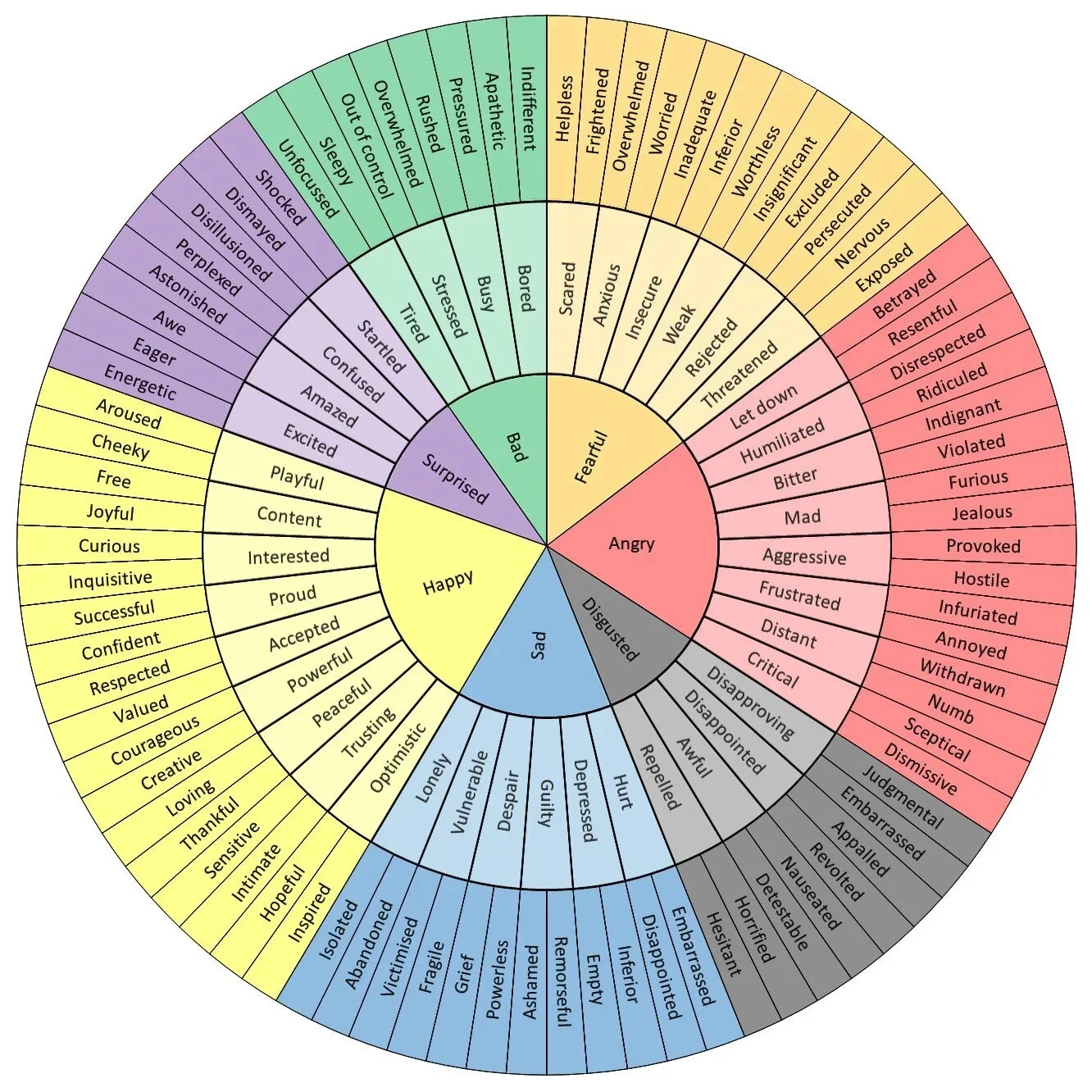
Core Feelings Wheel
How To Practice Empathy (specifically with a loved one)
Empathy is a pre-problem solving skill. When logic, explanation, and what you think arrive before emotional attunement, the emotional experience gets dismissed and a partner may feel distant from you.
First, think about empathy as presence. If your partner states “I feel hurt,” empathy isn’t “why would you feel that” or “what can I do.” Empathy sounds more like “I hear you’re hurt. Something about this was painful for you. Can you tell me more?” When you’re touching and staying present with the emotions your partner feels or has expressed, you’re giving them a non-verbal hug and staying still vs. gently shoving them out the door.
Secondly, separate facts from feelings. Go straight to acknowledging the feeling, even as you do not understand it yet by stating “I hear you saying you feel hurt, sad, and angry about what happened.” Identify other emotions that are visible or ask “what else are you feeling.” Work backwards. Try to imagine the events, internal or external, that led to that specific feeling.
Third, recognize empathizing through perspective taking is not agreement. For example, let’s say you are a medical doctor and get home from a grueling 12 hour shift and when checking in with partner, he states “I’m exhausted too...I had a long day.” You might be inclined to argue with him about how he doesn’t have a right to feel this way given you know he had several hours to rest that day and because you feel it’s unfair he even gets to make such a claim given the day you had. Note: you may disagree with who had an objectively harder day, but you can’t disagree with his feeling. As hard as it may be, you can state “I’m too tired to make space to hear more right now, but I hear you saying you’re depleted too. Even though you’re also tired, would you be able to stay up with the kids? I desperately need sleep.” Instead of arguing with the feeling, recognize it and then ask for what you need.
Fourth, check your gut reaction to get rid of the feeling or dismiss it. Avoid stating “you’re overreacting,” “it’s your fault you feel that way,” or “let me cheer you up” or “you can choose to interpret this differently.” Though this last one is valid later on, first make perspective-taking statements to validate the feeling. You can also ask “do you want me to just empathize or do you want solutions or my thoughts?”
Lastly, attempt to mirror the emotion via your tone, body language, staying with the story, or actions. This is moving from cognitive empathy to embodied and compassionate empathy. Even if you still don’t understand the feeling, soften, speak with warmth, and just listen if that’s what your partner needs. My favorite example of this is when the character Sadness stays emotionally attune with Bing Bong in the film Inside Out. It’s an easy and beautiful example of how empathy is sometimes the best solution to helping someone feel better.