“One falls in love, and then learns for the duration that one is at the mercy of someone else’s childhood” – Hanif Kureishi
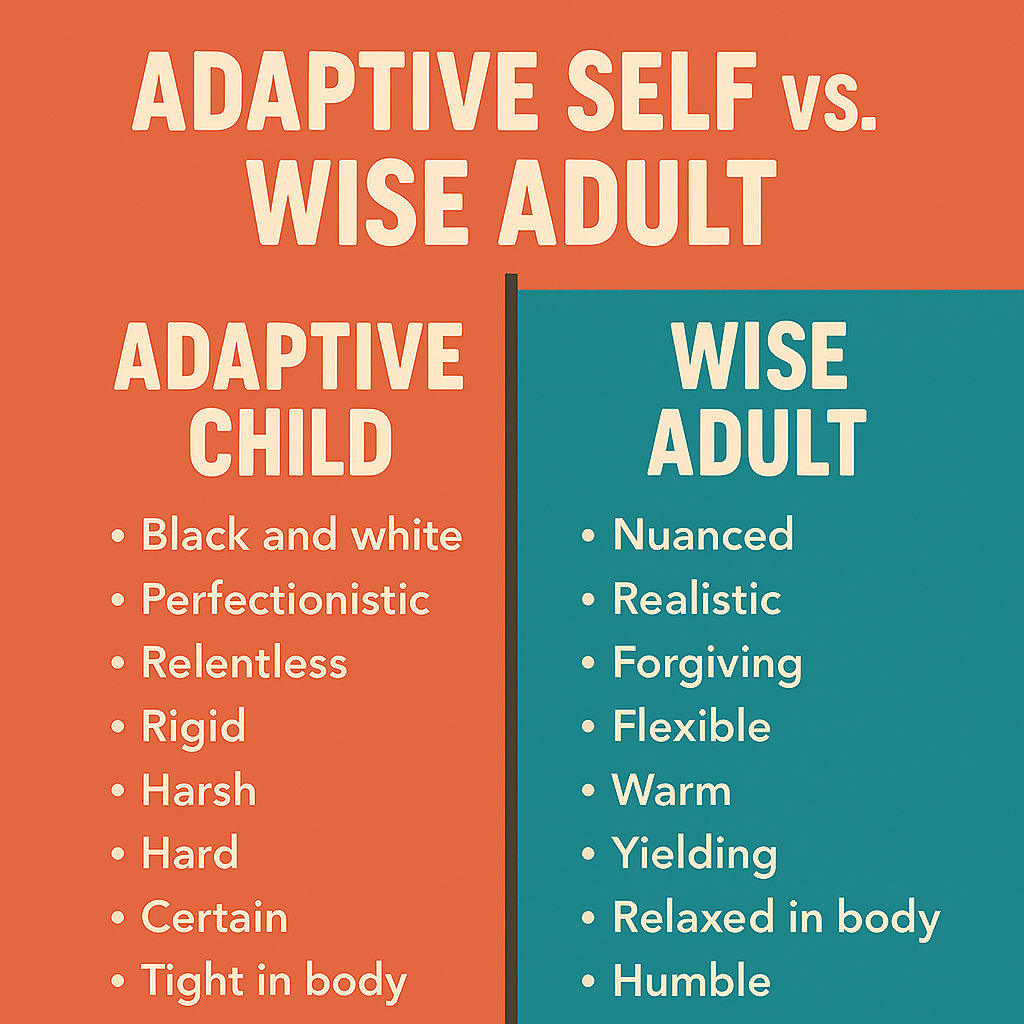
Contrary to popular belief, we do not marry people and their families. We marry people and their childhoods. Real argues in the therapy room, he is either speaking to the wise adult self, the mature and integrated self, or the adaptive child, the self that reacts via the prism of childhood experiences or trauma (not the acute type of trauma we think about…more everyday subtle emotional injuries that add up). The adaptive self comes out in moments of trigger and developed to cope with any version or slice of unhealthy parenting most of us got.
When we think of modern day “good” parenting, we think of nurture, guidance, and limits. Ask yourself the following to assess if you were part of the 1% (I’d like to think I’m not being sarcastic) who received this type of parenting:
Was my curiosity nourished?
Did I experience honest family discussions?
Was I read to?
Was I given hugs, kisses, cuddles, doting gestures?
Were I given information about my sexuality in a non-shaming way?
Did my parents have an inner emotional life and help in creating mine?
Was I met with patience and kindness when I made mistakes?
Were emotions expressed in a healthy way?
Could I turn to my parents in moments of vulnerability or hurt?
In the absence of these combined with neglect, abuse, or chronic invalidation, we resort to enacting dysfunctional patterns of coping in the face of interpersonal stress and tension. Though we can argue some parts of the adaptive self are driven by innate personality, most can be modified with deliberate internal work.
Note: how many people do you know who show up in relationships with some or all adaptive child qualities? Though some of these traits are great when you’re working in specific STEM or corporate fields, they are guaranteed to make your romantic relationship worse.
There’s no redeeming value in harshness
I appreciate Real placing a heavy emphasis on the fact that there’s nothing harshness can do that loving firmness can’t do better. What is harshness? It’s contempt, shaming, putting someone down, lacking in curiosity, empathy…just being plain mean. It has no place in relationships, particularly with those we claim to love.
Four types of injury or relational trauma
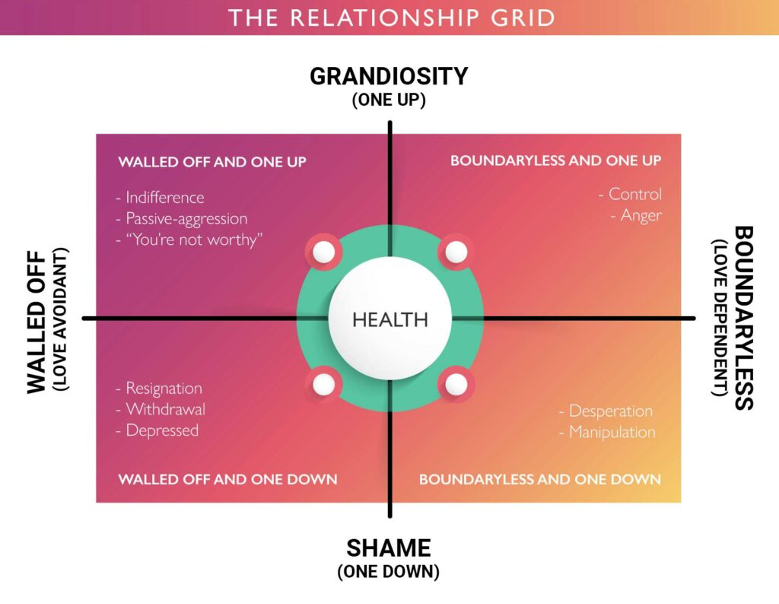
Real posits that there are four stances the adaptive child operates from depending on one’s specific history along two continuums: the severe neglect—overbearing line and the bolstering of a false/overinflated ego—worthless/subjugated line. Being in any one of these four quadrants signifies one is constantly either in a “one up” or superior stance or “one down” and inferior stance to others and either cutting off and coldly distancing or being intrusive and domineering. Shame and grandiosity are connected via the emotion of contempt: one is directed outward, another inward.
False empowerment isn’t always a cover for shame: some people were given false self-esteem by being the family hero, their parent’s confidante, the star performer, etc. False empowerment can also come when well-intentioned parents reinforce how “great” their kids are in the absence of fostering grit and resilience in the face of failure and reinforcing a more three dimensional identity that can honestly assess both strengths and weaknesses. Children are also inherently selfish and this tendency needs to be nurtured out of them via teaching them empathy and being sensitive and yielding to others. Being valued for your function or how you compare to others creates a self-esteem script that is contingent on being above or below others. Healthy self-esteem is feeling neither superior or interior to others.
Real also asserts that we can either be reactive or model what a parent taught us. Reactive responses are resisting the way our families viewed us. In modeling, we unconsciously internalize and replicate it. Growing up, I had a very harsh dad who spoke to with me all sternness and contempt and no softness in his punch. Even as a highly attune, mature, and skilled psychologist, this painful template sometimes finds its way onto my kids. Though I can’t take these moments back or always stop them when they lurch out, I always make sure to apologize and take responsibility for the fact that I want this script to slowly leave my system as I keep parenting with patience and empathy when I’m setting firm boundaries or limits.
Changing how you react can sometimes feel like rewiring your hard drive and is what Real calls relational heroism: the moment when every muscle and nerve in your body is screaming to do the same old thing but through hard work, discipline, insight, and maturity, you choose to do something else. These are the moments when everything is telling you to say “I’m done. I hate you too” but instead you say “I still love you. I feel stuck and so hurt, but I’m still here.”
The Toxic Marriage between Individualism and Patriarchy
Real writes:
Individualism teaches us that we stand apart from nature. What’s what the very word means: to be a separate entity. And patriarchy teaches that we stand above nature and are in control of it—no matter if the nature we seek to control is our partners, our kids, our bodies, are very thoughts. The exact same delusion that wreaks havoc at a global level sows discord and disconnection in our most intimate lives.
Our partners literally shape the physical trajectory of lives as the health of the emotional bond co-regulates our nervous system, cortisol level, and immune response. Choosing to enact a power over/right vs. wrong/objective truth always/ me vs. you mindset to the most important dynamic in your life will have an adverse impact on your relationship and overall happiness and health. It’s really not worth it to keep operating from this outdated adaptive self state.
Connected to the myth of individualism is patriarchy. Real has written a lot about masculine gender role stress and the socialization processes that robs young men of their vulnerability, relational needs, and emotional lives. Traditional masculine norms co-opt the idea of “strength” as being unemotional, not needing, and being in control and unaffected. These traits are necessary when men are literally at war and have to execute military orders, but the intergenerational transmission of these norms wreaks psychological havoc for men’s mental health. Women in these types of heterosexual dynamics can also reinforce these norms. The shift from individualistic to relational thinking and behavior is a skillful art that requires humility, a reframing of dignity, power, strength, and choosing connection over control. Many men lack role models for this…I recently watched this interview with Graham Planter (he’s running for the Democratic Senate seat in Maine…he’s not without his mess ups, but I do appreciate the man’s honesty) where he points out that using power over others is an act of a coward (amen) and it’s possible to be traditionally masculine in some ways and still and go to therapy, show emotions, and be vulnerable with others. The more men see their peers and trusted others live this way, the more likely they are to make a change.